
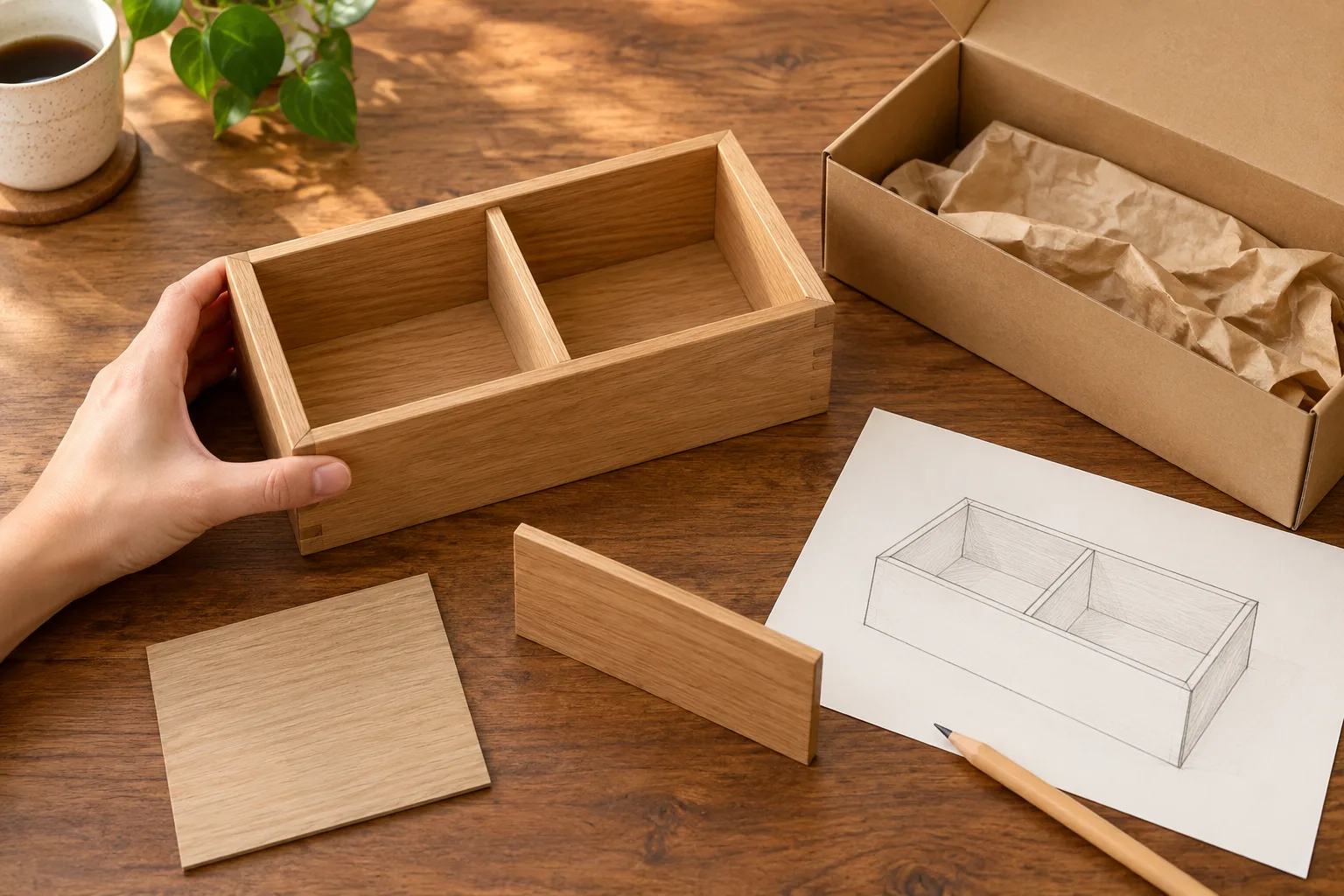
AI-generated images in this guide are conceptual illustrations.
The sample looks right in the supplier’s photos. But will the phone fit with its case on? Will the gift box close with the insert inside? Can the tissue refill pass through the loading opening? Those are the checks that turn a promising appearance into a useful product review.
Approve a wooden product sample by checking what the product must actually do—not just how it looks. Review fit, everyday operation, appearance, the applied logo and the complete pack. Then tell the supplier which features you accept, which need changing and whether bulk production may begin.
You do not have to reject an entire sample because one detail needs work. You do need to make that detail—and the next step—clear.
Before you reply, answer three questions
Before replying to the supplier, ask yourself:
- Have I tried it as the customer will use it? Use the actual contents, including cases, inserts and accessories; open, close, load and retrieve them.
- Am I reviewing the intended product? Check the inside, underside, current logo and proposed packaging—not just the most attractive face.
- What does my reply authorize? Distinguish a feature that passed, one that failed and one that has not been checked; then state whether production may start.
If you have only reviewed photos, start with the physical checks below. A missing check is not a defect: it tells you what you still need to find out.
First, know what kind of sample you have
A shape model, finish swatch and functional sample serve different purposes. A color swatch cannot tell you whether a lid closes. QIMA’s sample-review guidance likewise separates reviews by development and production stage.
Identify the sample and its intended drawing or specification, including temporary parts. If the intended dimensions or contents were never defined, use the wooden product RFQ guide to fill those gaps before treating a personal expectation as an agreed requirement.
Check usable space—not just outside measurements
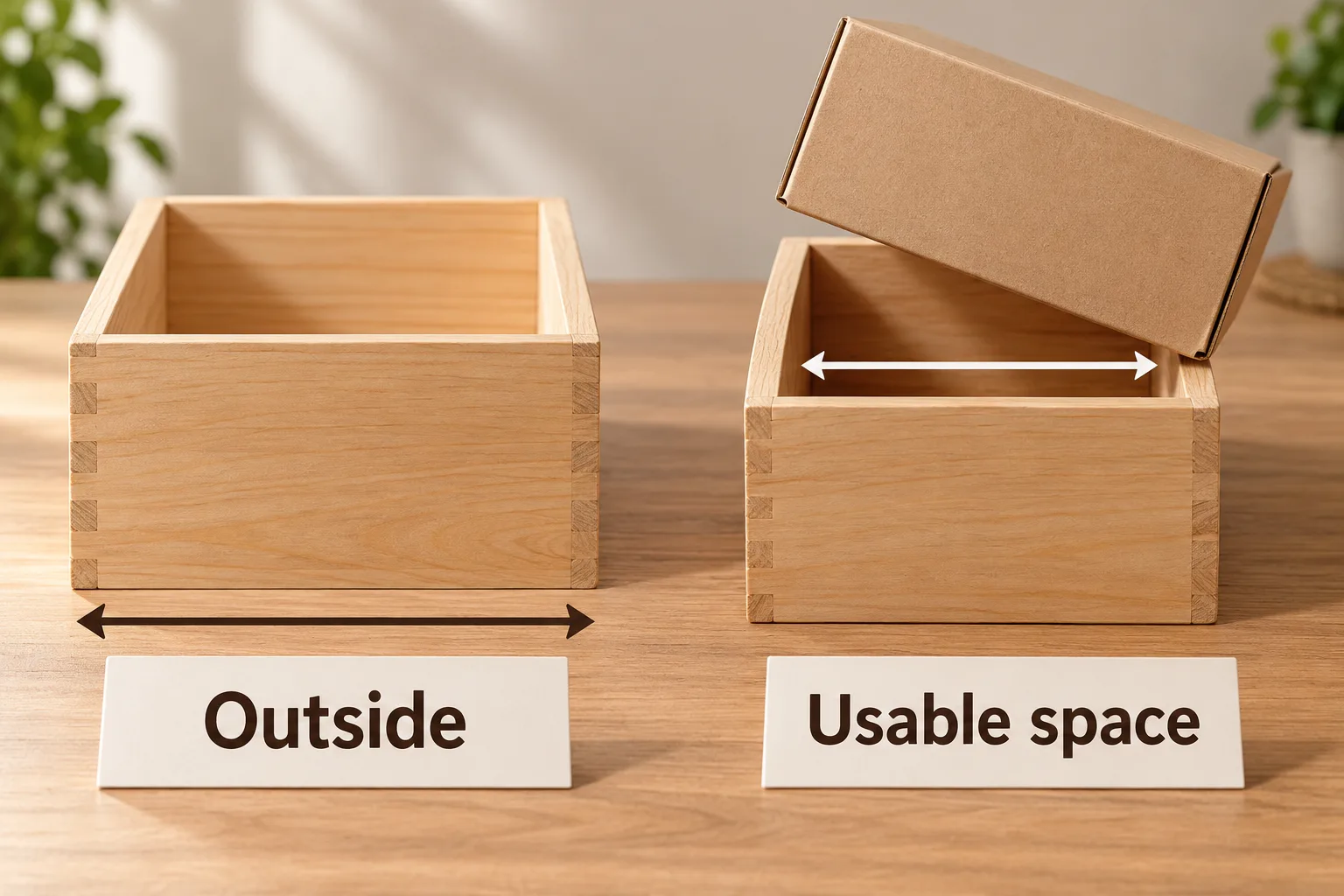
An outside dimension tells you how much room a product occupies. It does not tell you whether the contents can pass through the opening, sit correctly inside or be removed comfortably.
Use the actual item or an agreed representative. Check the narrowest point and the complete loading route, with the relevant insert, lid or accessory in place.
| Product | A practical check to perform |
|---|---|
| Tissue box cover | Load the intended refill, pull tissues through the opening and replace the refill. |
| Desk organizer or phone stand | Insert the intended stationery or phone with its case; check access and retrieval. |
| Gift or storage box | Pack the actual contents and insert, then close and reopen the box. |
| Ornament or hanging accessory | Fit the cord or attachment and try the intended display arrangement. |
Record the location and result: “refill catches at the bottom opening” is more useful than “size not good.” Measure critical points against the agreed requirement, keeping the units clear. There is no single dimensional tolerance that suits every wooden accessory.
Try the movements and contact points
Operate the product as the user will. Look for drawers that catch, lids that need extra pressure, a stand that rocks on the review surface, exposed fasteners or an edge that marks the contents. A short video is useful when the problem appears only during movement.
Describe the symptom before deciding the cause. A tight drawer might involve dimensions, alignment or finish buildup; environmental conditions may also matter. USDA guidance explains that wood exchanges moisture with its surroundings. That is a reason to record conditions, not a reason to excuse every fit problem as “natural wood.”
After a change, repeat the checks it could affect. Widening a phone slot may alter a neighboring compartment; changing a closure may affect the pack.
Review appearance and finish as separate questions
Compare the physical sample with the agreed color and finish reference under consistent lighting. Check visible faces, edges, interior and underside according to the intended use. Note scratches, glue residue, rough areas, cracks, loose joints or uneven coating by location.
Natural grain and color variation need an agreed range, particularly for a collection. One attractive sample does not define that whole range. Equally, natural variation is not a blanket explanation for workmanship defects.
Use unfiltered review photos with reference details visible. Marketing images—including edited product photos—can show the design, but should not be the sole reference for disputed color.
Appearance and performance are different decisions. USDA finishing guidance distinguishes appearance, protection and cleanability. If the intended use involves repeated cleaning or moisture exposure, define the relevant evaluation separately. A color match does not answer those questions.
Check the applied logo and the product in its pack
Compare the logo on the sample with the current artwork: wording, orientation, size, position and legibility. A digital proof helps check layout; the applied sample shows how it appears on the finished wood.
For packaging, check:
- Completeness: product, inserts, accessories, labels and variant identification.
- Fit and presentation: contact points, movement, closure and unpacking with the intended contents inside.
- Transport requirements: the packing configuration and any agreed evaluation for the planned shipping route.
Receiving one undamaged sample does not demonstrate how a production shipment will perform. If the final pack is absent, keep that review separate rather than marking packaging accepted.
Write one clear decision: accept, revise or check
Keep a compact record: the item, what you observed, your decision and the next action. Use the sample and file references so both sides are discussing the same version.
| Decision | What it means in practice |
|---|---|
| Accept for the stated scope | This checked feature meets the agreed requirement. |
| Revise and recheck | A specific change is needed, followed by the relevant check. |
| Not yet checked | The contents, pack, requirement or evidence needed for a decision is missing. |
Then give a separate production instruction. Accepting the finish does not also approve untested fit or an outdated logo. State whether production is on hold or authorized, with any limited scope expressly agreed with the supplier.
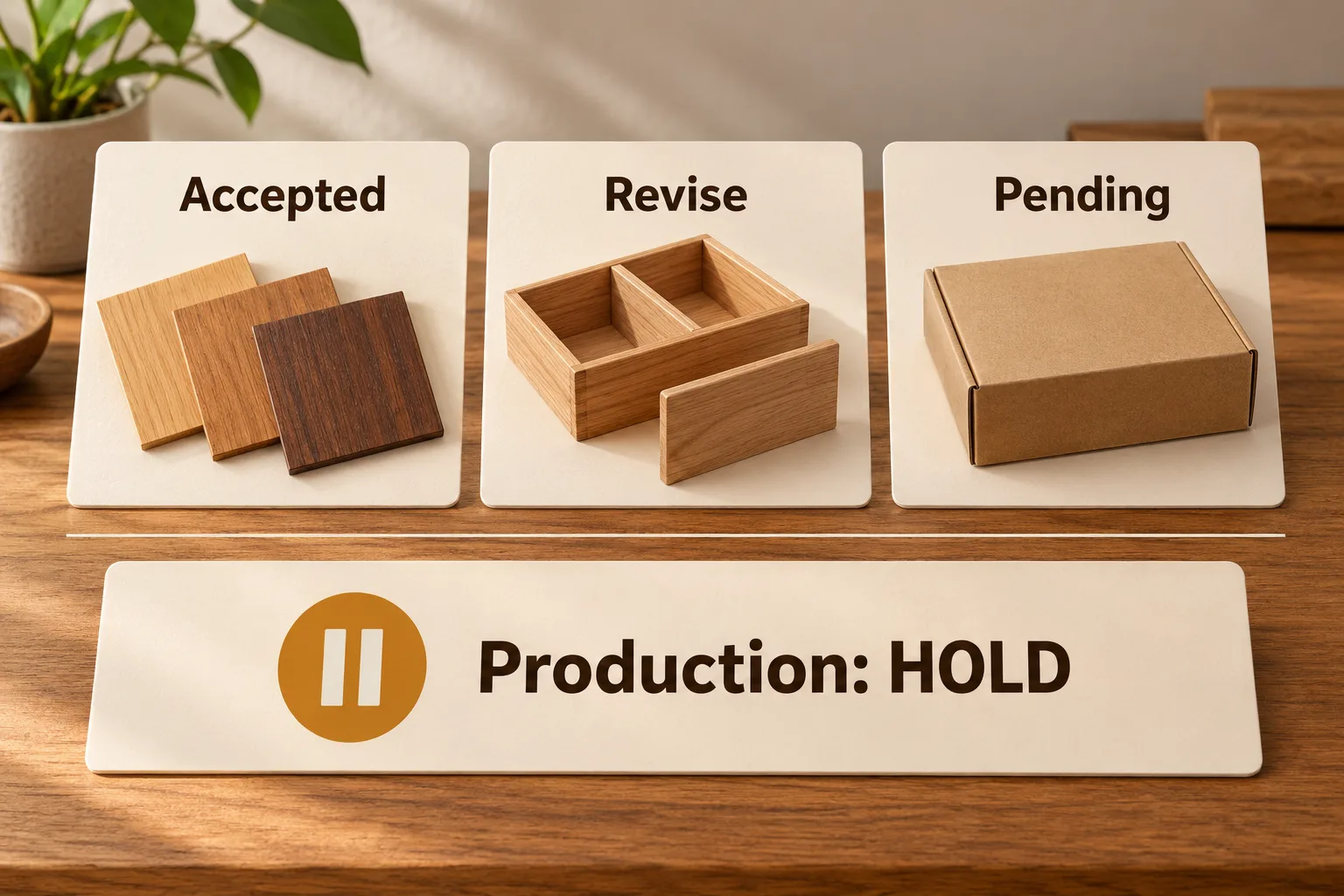
Example: the finish passes, but fit with the case is untested
In this illustrative example, organizer sample S-02 matches the agreed finish. A bare phone fits, but the buyer has not tried the intended phone case. The sample also carries the previous logo, and the final packaging has not arrived.
Here, the logo needs revision. The slot does not yet have a pass or fail result. The next steps are:
- Keep the accepted finish as the reference for this review.
- Try the intended phone with its case. If it fits and can be retrieved as required, keep the slot. If it catches, record where and assess a change before revising it.
- Review the revised applied logo and the product in its final pack.
- Hold bulk production while those product decisions remain open.
A concise reply could read:
We accept the finish of sample S-02 against reference F01. Fit with the intended phone case has not been checked; please check the current slot using the attached reference before proposing a dimensional change. Please also apply artwork A02 and provide the agreed packaging for review. Bulk production remains on hold until these checks and the logo revision are reviewed.
This avoids two mistakes: approving a fit that nobody checked, and paying for a revision before finding out whether it is needed. An unclear reply can instead lead to another sample round or a correction after more units have been made.
Keep the approved reference available for production
Retain the accepted sample and matching specifications. Record changes agreed after approval and identify which features need another check. Approval gives the supplier and buyer a reference for the checked scope; it does not prove that every unit in the eventual batch will meet it. Production and shipment inspection remain separate tasks.
If you are still deciding who develops the product or prepares the specification, start with the OEM, ODM and private-label comparison instead.
Bring the sample issue to Mepalwood
For your custom wooden product project, send the product or sample reference, relevant photos or a short video, the intended contents and target quantity. Tell us what you have tried and what is still untested; you do not need to diagnose a technical cause first.
Bring your sample review questions to Mepalwood to discuss which details can be retained, which need checking and whether a revision is necessary.


