
AI-generated images in this guide are conceptual illustrations.
You want a wooden organizer under your brand. One supplier asks for drawings, another offers a catalog design and a third talks about private label. Their quotations look different because they may be pricing different work—not simply charging different prices for the same product.
Start with what you already have: your own design, a supplier’s base product, or a reference that still needs development. A request for a different size does not, by itself, decide the route. First establish where the design comes from and whether an existing product can be adapted. Define the logo and packaging work alongside that choice.
Supplier terminology varies. The useful decision is what work your project needs and who will do it, rather than which acronym sounds most attractive.
Which of these three situations describes your project?
- You have your own drawings or a defined product design. Ask the supplier to review whether it can manufacture that design and identify necessary changes. This is an OEM-style discussion.
- You found a supplier’s product that is close to what you need. Start by assessing that base and the requested changes. It may remain an adaptation of the supplier-developed design rather than require a new design from scratch.
- You have reference photos but no settled design. Ask what development is needed before a production quotation can be reliable. A reference is a starting brief, not proof that every dimension and construction detail has been decided.
Logo and packaging work can accompany any of these situations. You do not need to settle the acronym before explaining which one applies to you.
OEM, ODM and private label at a glance
| Route or scope | Best starting point—and the trade-off |
|---|---|
| OEM: manufacture to a buyer-controlled design | Usually starts with the buyer’s product definition. The supplier reviews manufacture and any development still needed; the term alone does not promise a complete design service. |
| ODM: start from a supplier-developed design | Gives you a base to evaluate and adapt. Available changes depend on that design; catalog availability does not establish stock or exclusivity. |
| Private label: sell under your brand | Describes the brand-facing scope. It can accompany either design route, so it is not a third, mutually exclusive product-development method. |
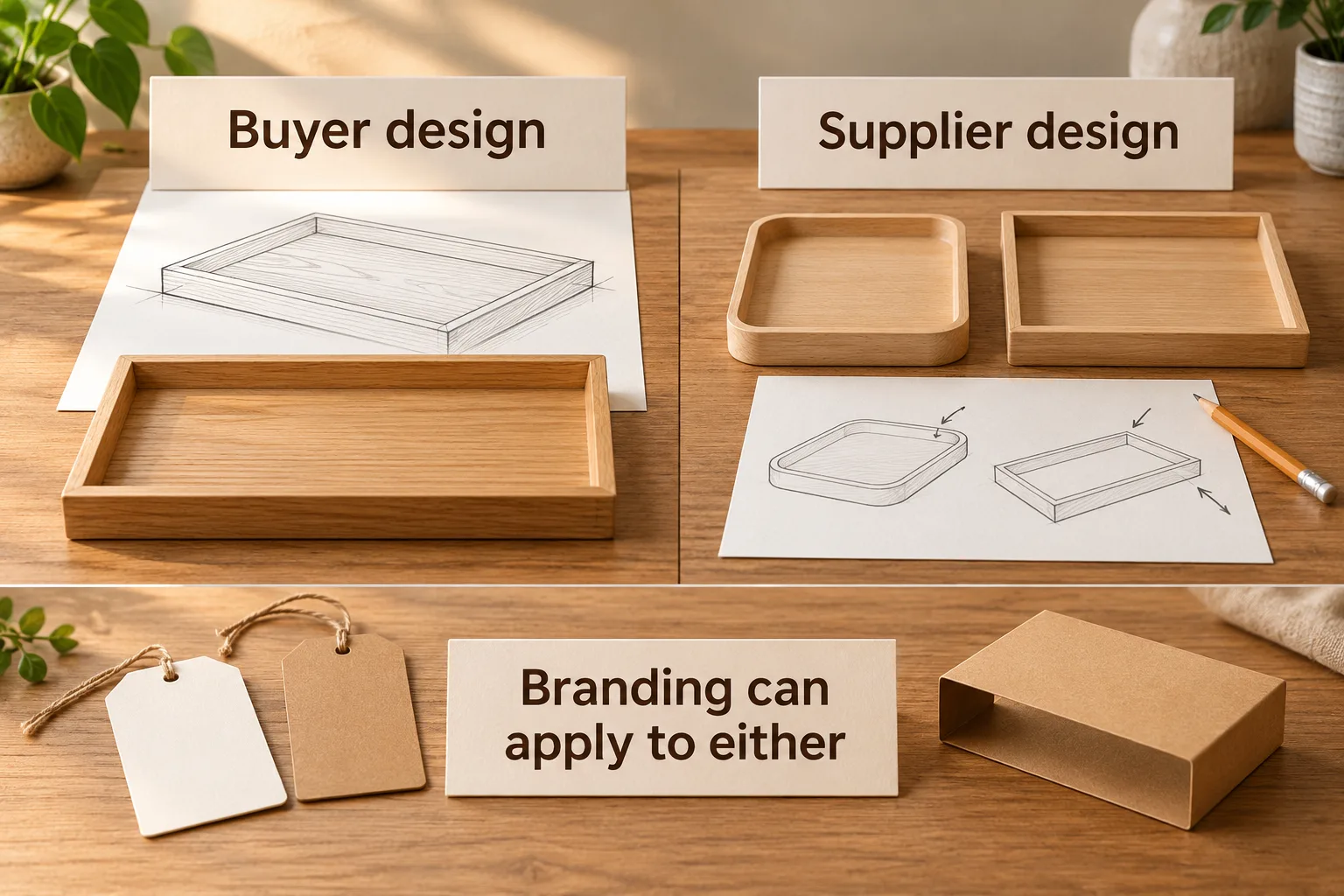
Have your own design? Review manufacture, not another catalog
If you have developed a particular layout, fit or construction, use it as the starting point for the supplier’s review. Identify the requirements that must stay fixed and those you are willing to change for manufacture. A proposal that changes the compartment layout is not an equivalent offer if that layout is the reason you developed the product.
You need not arrive with every manufacturing detail completed. If drawings, joints or other details still need development, include that work in the proposal. The trade-off is more control of the design in exchange for more decisions to develop and review—not an automatic promise of a better product.
Found a suitable base? Check what your changes affect
Compare the supplier-developed base with the actual contents and intended use. Then list the differences you need, rather than asking for a new product before checking what is already usable.
A color or logo change may leave the basic product intact. A new compartment layout, closure or loading opening may affect other parts and need more development. A size change can be either modest or substantial, depending on the construction; the word “custom” does not decide that for you.
The benefit is a design you can assess rather than a blank sheet. The limit is how far it can be adapted while still serving your purpose. If the changes remove most of that benefit, compare a separate development proposal. Do not assume that either route has a lower MOQ or a cheaper sample without comparing the actual scope.
Adding your brand? Separate product changes from logo and packaging
Private label answers “whose brand will the customer see?” Keep three parts of the request separate:
- The product: whether the existing shape, dimensions and function remain unchanged.
- The branding: artwork, application, position, size and the result on the chosen surface.
- The packaging: inserts, labels, retail presentation and the requirements of your sales channel.
A logo-only offer and a product-plus-custom-pack proposal are not equivalent simply because both suppliers call them private label. Adding a logo also does not make a shared base design exclusive.
Compare development work before comparing the price
Two suppliers can both say “OEM” while including very different services. One may price manufacturing from completed drawings; another may include design preparation, artwork proofs or packaging development.
Before choosing, put the main division of work in one short table:
| Workstream | What the proposal should make clear |
|---|---|
| Product design | The starting reference or base, required changes and who develops the missing details. |
| Specifications | Who prepares the proposed dimensions and construction, and who makes the buyer’s final decision. |
| Branding and packaging | What the buyer supplies, what the supplier develops and which proofs or samples are included. |
| Charges and deliverables | Development, sampling and production scope, exclusions, and the files or samples the buyer receives. |
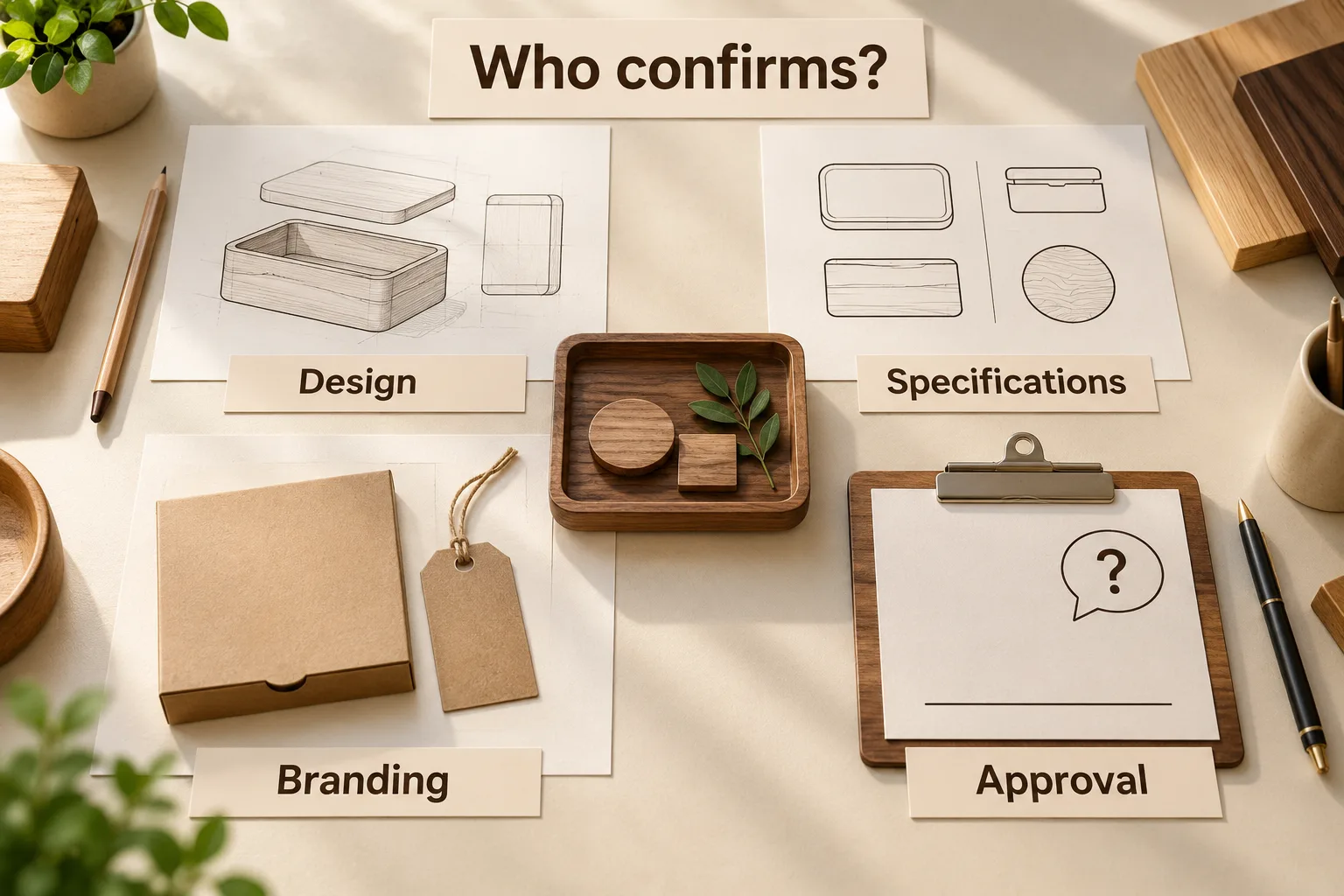
A low quotation can be incomplete rather than economical if it leaves out development you still need. Find that difference before sampling, when it can still change the choice of proposal, rather than after assuming the quoted cost and timing cover everything.
Use the wooden product RFQ guide for the detailed quotation inputs; you do not need to duplicate the entire RFQ in the model-selection discussion.
Example: choose a route for a branded desk organizer
In this illustrative example, a brand likes a supplier’s existing organizer. Its compartment layout already suits the intended contents. The buyer wants an underside logo and a retail carton, but does not need to change the product’s structure.
The initial choice is to discuss the supplier-developed base with private-label branding and packaging. There is no clear reason to commission a new product layout before checking that base.
Now change one requirement: the organizer must fit a specific device and cable route, and the existing compartment cannot accommodate them. First assess whether the base can be adapted. If it can, compare the adaptation scope and sample work. If it cannot, or the change effectively creates a new layout, discuss a separate design-development proposal. The requirement does not become “OEM” merely because it includes a custom dimension.
The first enquiry could read:
We are interested in your organizer base [reference] for our brand. We would like to retain the layout and discuss an underside logo and retail carton. Please separate the base product, branding, packaging and sampling in your proposal. Our intended contents are [details] and target quantity is [quantity].
This gives the supplier a route to assess. It does not require the buyer to know every production detail before starting the conversation.
Keep design rights separate from the sourcing label
For development work, agree the use of existing designs and files, ownership or licensing of new outputs, tooling arrangements and any confidentiality or exclusivity needed. WIPO’s supplier-agreement guidance highlights the distinction between pre-existing inputs and newly created outputs.
An OEM or ODM label does not determine legal rights. Obtain appropriate advice for the agreement and jurisdiction rather than assuming a development payment transfers every right.
Once a sample is available, move to the wooden product sample approval checklist for fit, finish, branding and packaging review. Choosing the sourcing route is not the same task as approving the sample.
Start the project conversation with what you already have
Send your drawings, reference photos or a base-product link, together with the intended use, target quantity and required changes. Say what you want to retain and what must be different.
Review Mepalwood’s custom wooden product service or send your reference and required changes to discuss whether to assess an existing base or a separate development scope. You do not need to choose the sourcing label first.


